CEO Lunch with Chancellor Friedrich Merz's Delegation in Singapore: AI Process Optimisation with the German AI Operating System ZiyaOS
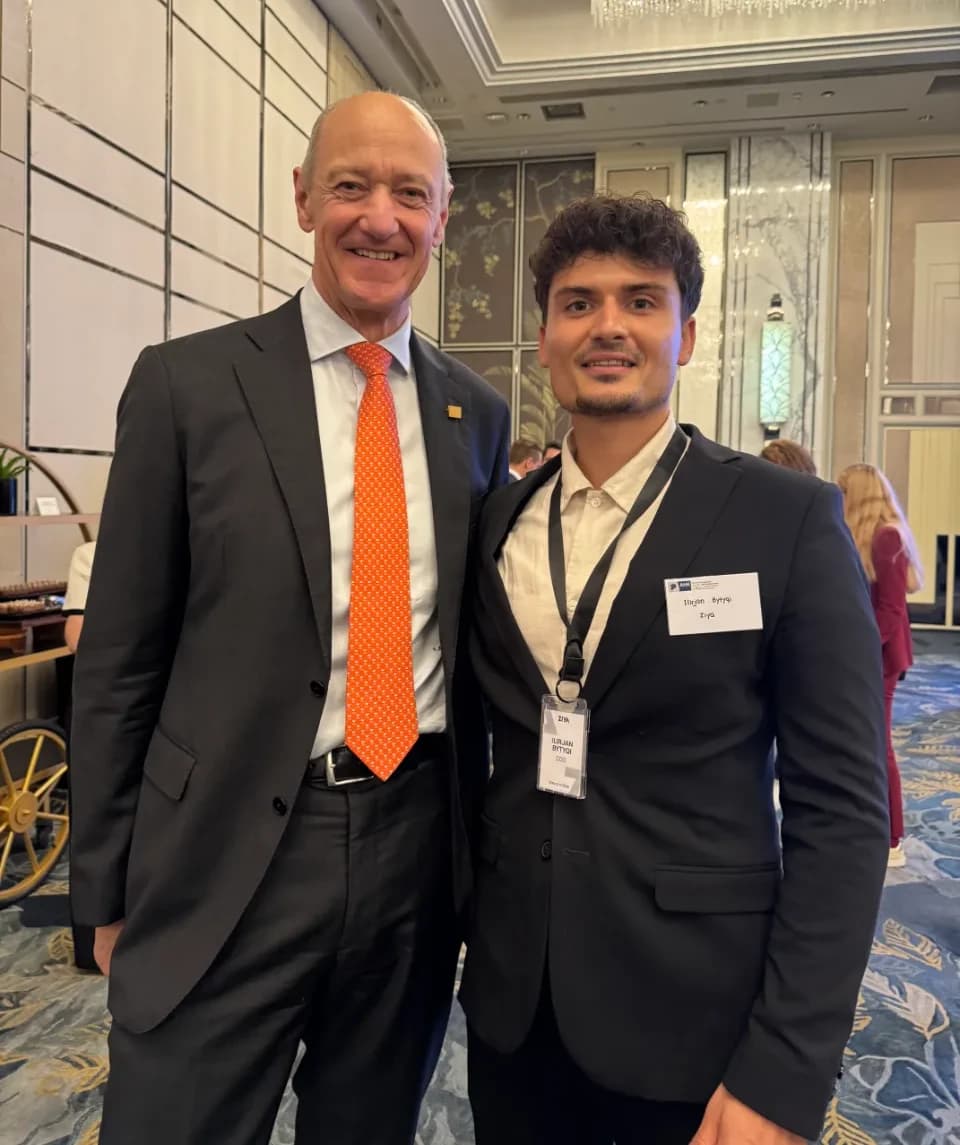
Two delegations, one table
A CEO lunch with Chancellor Friedrich Merz's business delegation, with the CEOs of some 30 of Germany's leading corporations, among them Roland Busch of Siemens. And Ziya right in the middle of it.
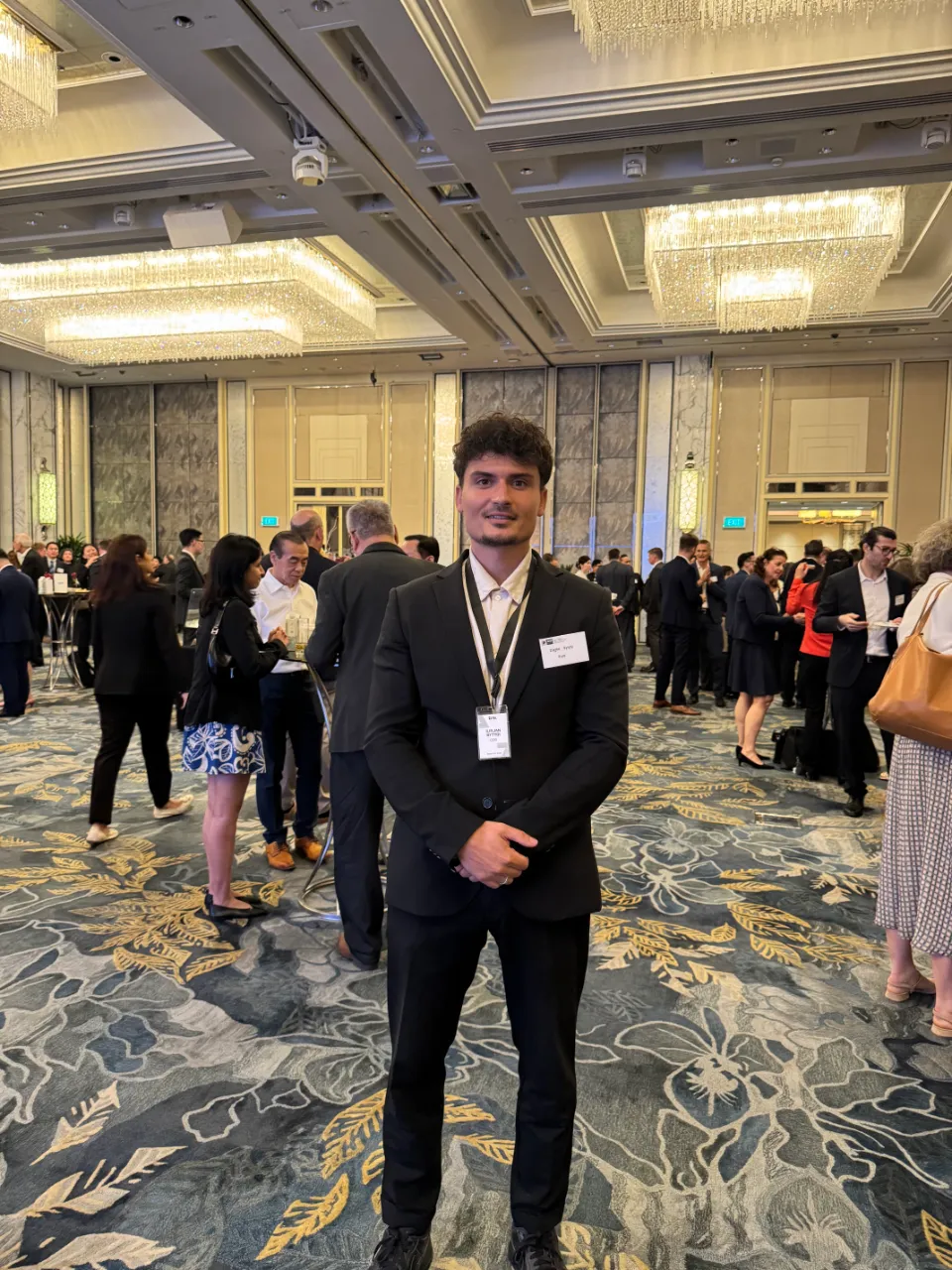
At the end of October I am in Singapore with the delegation trip of the Singaporean-German Chamber of Industry and Commerce, AHK Singapore for short. At the same time, Chancellor Merz was in the country with his business delegation, before the trip continued to Japan and South Korea. The two trips overlapped, and our delegation was part of the Chancellor's programme: keynote, a joint CEO lunch, networking.
Around the table sat the heads of Siemens, Telekom, DHL, Henkel, Airbus, Zeiss and many other corporations. For an AI company like Ziya, which has been building sovereign AI platforms for corporations and mid-sized companies since 2022, this is no ordinary appointment. It is the room in which German industry is deciding right now how it will use AI.
This post sums up what I take away from those conversations, why sovereign AI sits at the top of the agenda, and what I presented in the afternoon at the pitch in the Ocean Financial Centre: ZiyaOS, our AI operating system for German sovereign AI.
The political frame: the Chancellor's trip to Asia
From 26 to 30 October 2026, Chancellor Friedrich Merz travelled with a business delegation to Singapore, Japan and South Korea, with Singapore as the first stop. According to the German Federal Government, the trip is above all meant to deepen security and economic cooperation with these close partners in the Indo-Pacific and to give trade policy new impetus.
In Singapore, Merz met Prime Minister Lawrence Wong and President Tharman Shanmugaratnam and gave a keynote address as part of the renowned Singapore Lecture. The two governments agreed on a joint statement on their strategic partnership and a work plan for 2027/2028, focused on the economy, security, digitalisation and energy. Merz stressed that, alongside trade, both countries want to intensify their cooperation on digitalisation and AI. (Source: German Federal Government)
For us this is more than protocol. When two governments explicitly put AI at the centre of their partnership, it creates exactly the frame in which companies like Ziya can take the next step: German sovereign AI for one of the most dynamic economic regions in the world.
The mood: honest, but surprisingly positive
The mood in the delegation was more honest and at the same time more optimistic than the headlines would lead you to expect. Many corporations are facing big challenges right now, and nobody glossed over that. The economy is weak, and that was said openly.
Still, nobody complained. Quite the opposite. Almost every conversation came back to the same thought: AI is the key technology with which the German economy can turn things around. Not as an experiment in the innovation department, but as a lever for productivity, quality and speed in the core business.
That attitude is what gives hope. Anyone who names their challenges clearly and knows where the lever is, is already a step ahead of the many who are still waiting.
Over lunch I was able to have several one-on-one conversations, among them with Tobias Meyer, CEO of DHL. I want to pick out two of them here, because they go straight to the two topics that matter most for Ziya and for German industry right now: sovereignty and execution.
Sovereign AI is a matter for the top: the conversation with Tim Höttges
Tim Höttges, CEO of Deutsche Telekom, made it very clear to me how important sovereign AI within Germany and the EU is, especially for industry. His point: Germany is sitting on an enormous treasure of industrial data and know-how. That treasure has to stay here, so that it is used here and does not create value somewhere else.
Telekom shows that this is more than a speech, with its own money. Together with NVIDIA it has built the Industrial AI Cloud in Munich, a partnership worth around one billion euros with up to 10,000 NVIDIA Blackwell GPUs, which according to Telekom adds around 50 percent more AI computing power for Germany. The platform has been available since the first quarter of 2026 and is a flagship project of the "Made for Germany" initiative. Siemens, incidentally, is part of the partner ecosystem too. (Source: Deutsche Telekom)
I see it the same way. For corporations, sovereignty is not a question of ideology but of competitiveness. Whoever hands their process data, engineering knowledge and production experience to systems outside their own control hands over part of their lead.
That is exactly why we built ZiyaOS as an AI operating system for German sovereign AI. Where it runs remains the customer's decision: EU cloud, on-premise or fully air-gapped. Models are a setting, not a dependency. A central model gateway runs Claude, OpenAI or your own open-source models on your own hardware. German owners, German and European law, developed and operated in Dortmund.
Results open doors: the conversation with Roland Busch
With Roland Busch, CEO of Siemens, I talked personally about our joint work: AI agents that we developed together with Siemens AI engineers at the Siemens plant in Berlin. On site, in just under a week, and brought into production together.
This is the part I am especially proud of. Not a proof of concept that ends in a presentation, but agents running in the real operation of an industrial plant. Built in days, not quarters. It is exactly this experience that opens doors in conversations at this level: results speak a different language than slides.
Siemens sees itself as a leader in industrial AI, and at the launch of the Industrial AI Cloud, Roland Busch described AI as a key technology that makes companies of every size more productive and more competitive. That industrial AI has the greatest impact where it works directly in engineering and production matches our experience from Berlin completely.
We want to deepen this collaboration further. For us, the agents at the Berlin plant are a beginning, not an end point.
After the CEO lunch comes the pitch: AI belongs in the processes
The second half of the day was about AI in process optimisation. At the AHK Singapore pitch event in the Ocean Financial Centre, six scale-ups from our delegation were invited to present their solutions. Ziya was one of them, and I pitched ZiyaOS, our AI operating system for AI process optimisation in large enterprises.
My core message was simple: AI belongs inside the processes, not next to them.
In many companies, AI runs on the side today. A chat window here, a pilot there, a copilot that some people use and many do not. That is not useless, but it only scratches the surface. Most of the potential stays untapped, because the AI does not sit where value is created: in procurement, in sales, in project management, in service, in production.
The difference is fundamental. AI next to the process answers questions. AI inside the process gets work done. It accesses CRM, ERP, files and mailboxes, knows the company's rules and acts on behalf of an accountable person. Only then does a tool become a lever for productivity.
The real problem: speed and resources
Individual processes need individual AI. Every corporation has its own workflows, systems and quirks. An off-the-shelf app rarely reflects that. Anyone who wants to unlock the full potential has to build their own AI solutions for their own processes.
The catch: a single AI project today often takes several months, sometimes considerably longer. It swallows budget, internal resources and the IT department's attention. And it starts over with every use case.
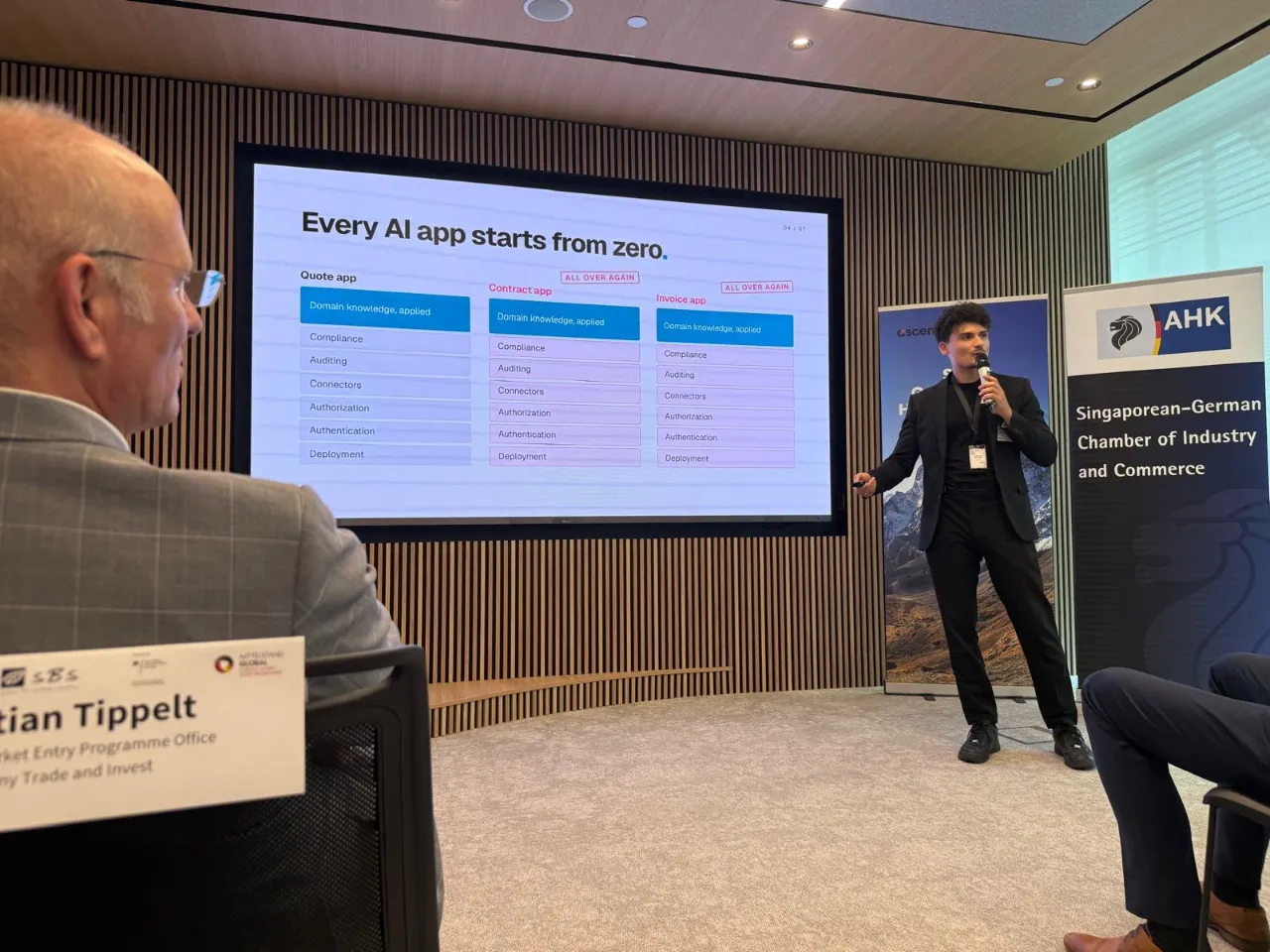
Now comes the calculation that few boards make out loud. A corporation quickly has more than 100 business-critical use cases where AI would make a real difference. If each of them is a project of its own lasting months, it simply cannot be done. It is not ideas that are missing, it is time, money and people.
In the end, three bad options remain:
- Buy apps. A separate tool for every department. The result is an app zoo with separate logins, data silos and licence costs that add up.
- Build everything yourself. For every use case, the same foundation is developed, reviewed and operated all over again. Expensive and slow.
- Wait. The most comfortable option and the most dangerous one, because the competition is not waiting.
Why does it take so long? Because most of every AI project has nothing to do with the actual use case.
The 80 %: the foundation that repeats every time
Our observation from many projects: around 80 % of every (Gen)AI project rests on the same foundation. Whether it is a sales assistant, a procurement agent or a service app, underneath there is always the same stack. And it is exactly this stack that eats most of the time, because it is rebuilt, secured and taken through security review for every single use case.
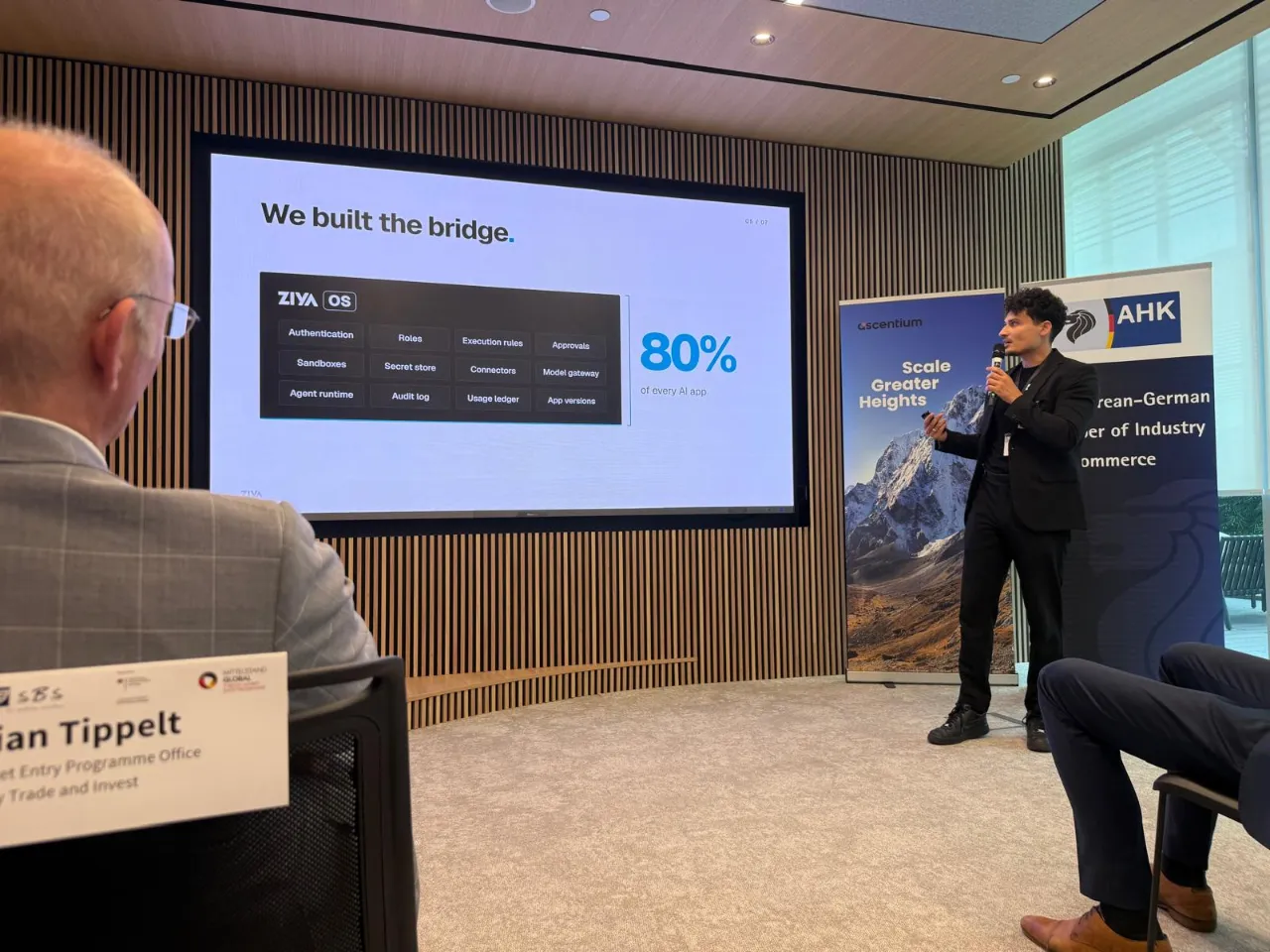
In ZiyaOS, our AI operating system, this foundation is already solved. Set up once, every new app inherits it from day one:
| Building block | What ZiyaOS brings to it |
|---|---|
| Single sign-on and permissions | Sign-in through the existing identity provider, groups are carried over, and before every action it checks what a person is allowed to do |
| Connectors | Connections to CRM, ERP, databases, files and mail; every access by an agent passes through a gate that checks whether it is allowed |
| Agent runtime, agents and skills | A runtime for agents and reusable capabilities, built from the ground up for token efficiency |
| Sandbox | Every app runs in isolation, with rules per data source: reading runs, writing asks first, deleting is blocked |
| Cost control | Token costs and results are attributed to the accountable person |
| Model gateway | Model-agnostic: Claude, OpenAI or your own open-source models, switchable like a setting |
| Audit | Every request, every access and every model response is logged; who did what and when can be traced at any time |
| Compliance and deployment | Runs in the EU cloud, on-premise or fully air-gapped, under German and European law |
The principle behind it: set the rules once, and every app follows them. IT sets up the foundation once and stays in control. Every further app runs within these guardrails automatically, instead of becoming a new risk.
The 20 %: the gold in the heads of the business departments
Once the foundation is in place, what remains is the part nobody can buy and nobody can copy: the domain knowledge of the people who live the processes every day. The buyer who knows which supplier is shaky on which component. The project manager who knows which metric really counts. The service expert who knows the typical failure patterns in her sleep. These 20 % are a thin layer, but they are the real gold.
With ZiyaOS, exactly these experts get the freedom to turn that knowledge into their own apps. They describe their process, and a coding agent builds the app. Vibe-coded, but not flying blind: every app is created and runs in a secure sandbox and sits on the foundation described above. Connections, permissions and audit are there from day one.
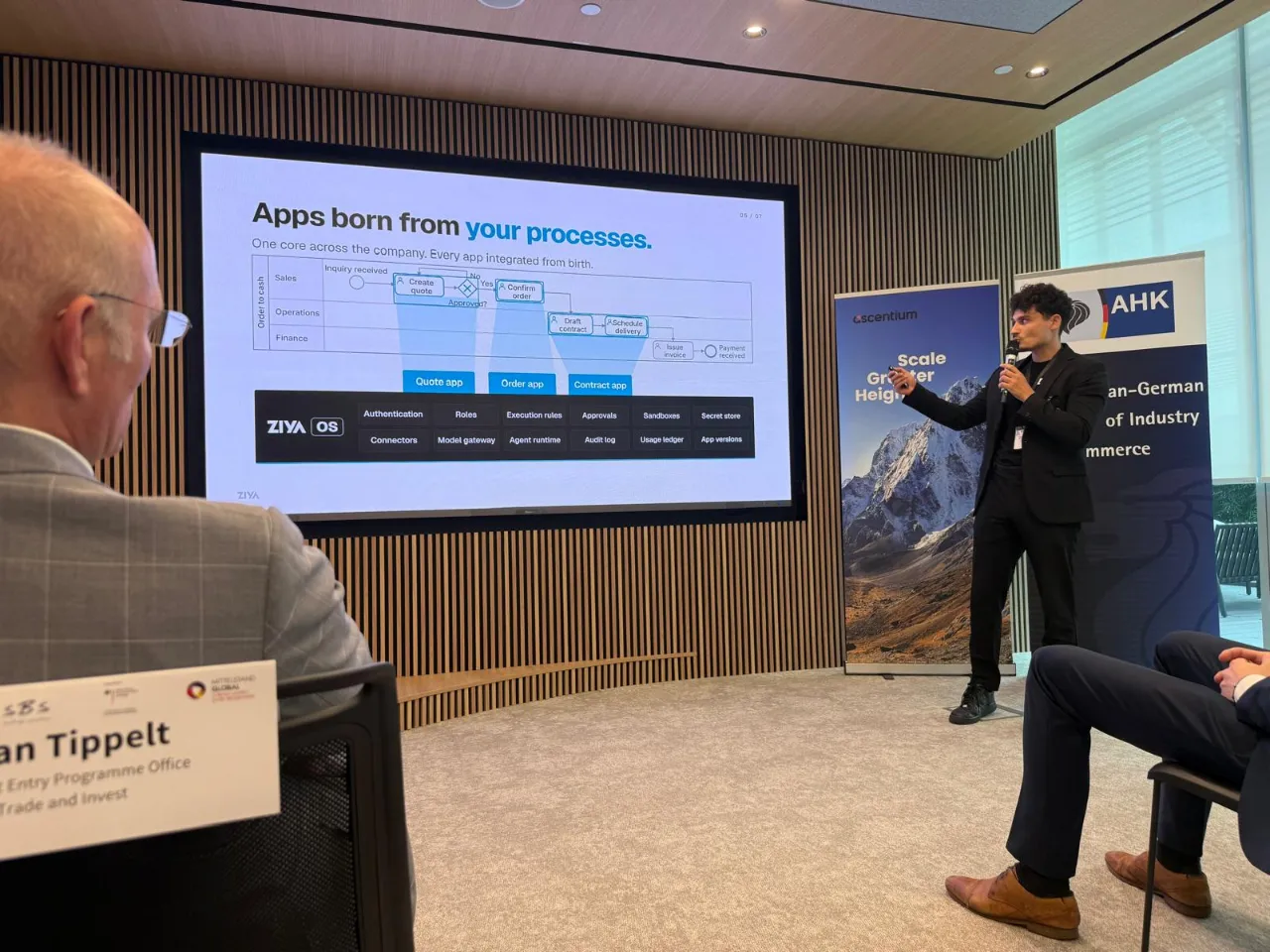
Once an app is finished, it is not forgotten as an isolated solution on someone's laptop. It is shared across the whole corporation, with finely adjustable permissions. Who may use it, which data it may access, what it may write: all of this is clearly governed for every app and every role.
Three paths lead to an app:
- Business departments describe the process, and the coding agent builds the app.
- IT or partners develop with the app SDK and low-code.
- Ziya delivers when a company describes the process and wants the finished solution.
An everyday example: a single request such as "Create a presentation from the last customer meetings and the current project data and send it to the customer" touches sales, projects and mail. In ZiyaOS, every one of these accesses passes through the gate, is checked and is logged. That is what AI inside the processes feels like.
The result: individual AI use cases are up and running in days to a few weeks instead of months. The first pilot is typically in production within two to six weeks, and every further app runs on the same core and under the same rules.
The conclusion: security and speed, finally together
Until now, corporations had to choose. Either security: every new AI application goes through architecture, data protection and security review, with the result that after a year three use cases are live. Or speed: business departments quickly build their own solutions, and IT loses track. One slows you down, the other becomes a risk.
An AI operating system resolves this conflict. The security sits in the foundation, set up once and binding for every app. The speed comes on top, because domain experts can build app after app without starting from the foundation every time. One project per quarter becomes dozens of AI apps that are actually in use.
In the race for AI, both count. Whoever is only safe gets overtaken. Whoever is only fast hits the wall. The companies that bring both together now will not capture a fraction of AI's potential in their processes, but all of it.
That is exactly what ZiyaOS is: an AI operating system made in Germany for German sovereign AI. One core, many apps, one set of rules.
Singapore is ready for ZiyaOS. And we are ready for Singapore.
The rush after the pitch was overwhelming. What inspired me most was the mindset of the German subsidiaries here in Singapore: open, curious and with a clear sense that AI now has to move into the processes.
From the ASEAN CEO of a huge German retail chain, to Adrian Leonardi of AUMOVIO, who gave a strong keynote, to the colleagues from Siemens Singapore and many other companies and partners on site: the conversations showed that the need is huge not only in Germany. More and more companies want to unlock the full potential of AI, and they are looking for a way to do it quickly and safely.
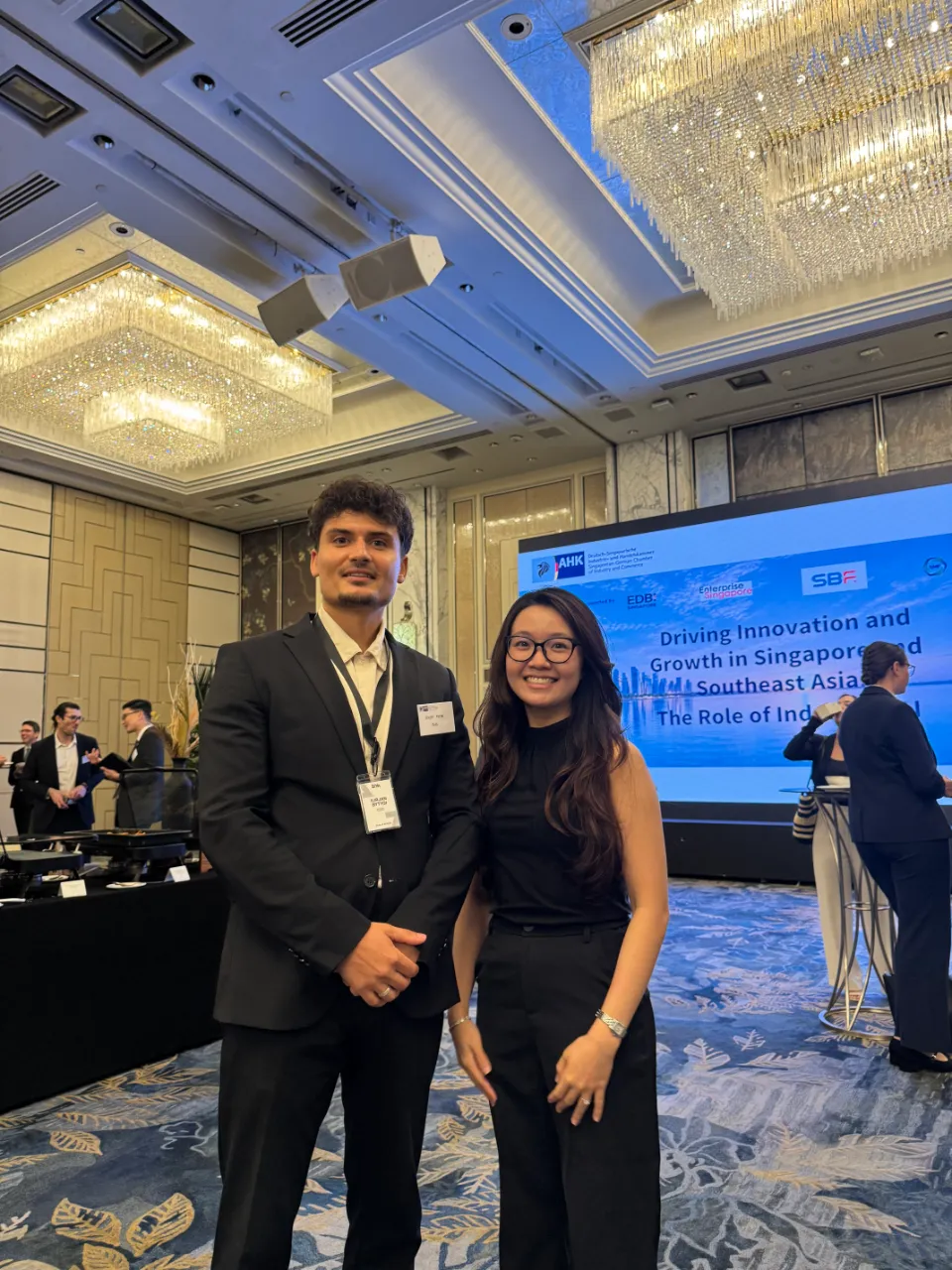
Just as valuable was the exchange with Bernd Hermann, CFO of TÜV SÜD in Singapore. The network on site was impressively broad altogether: alongside companies, numerous network partners took part, above all the Singaporean-German Chamber of Industry and Commerce (AHK Singapore), the German Centre Singapore and many other representatives of the German-Singaporean business community.
Singapore is a hub for the entire ASEAN region, and German corporations have a strong presence here. For Ziya and our AI operating system it is a natural next market: the same questions of sovereignty, control and speed arise here just the same, only under different circumstances.
Where does AI stand in your company?
Is AI in your company still sitting next to the processes, or is it already right in the middle of them? If you want to find out how quickly your first AI use case of your own can be in production, the path is short:
- Live demo: 30 minutes in which we show ZiyaOS on a real process.
- Pilot: your first app of your own, in production within two to six weeks.
- The next apps: on the same core, under the same rules.
More at ziya.one.
Special thanks to Dr. Thai-Lai Pham, CEO Siemens ASEAN, for the photo with Roland Busch.
Sources
- German Federal Government: Neue Impulse für die Handelspolitik, Chancellor Merz's trip to Asia (27 October 2026)
- Deutsche Telekom: Für ein souveränes Deutschland: Telekom startet Industrial AI Cloud mit NVIDIA (4 November 2025)
Your first step to AI success
Your contact
Ilirjan Bytyqi, M.Sc.Operations Manager at Ziya GmbH- Email Ziya
- info@ziya.de
- Call Ziya
- +49 157 36802836